 Dartastic Pub
Your private pub.dev.
A private pub.dev for your teams. Publish and share packages on your own infrastructure.
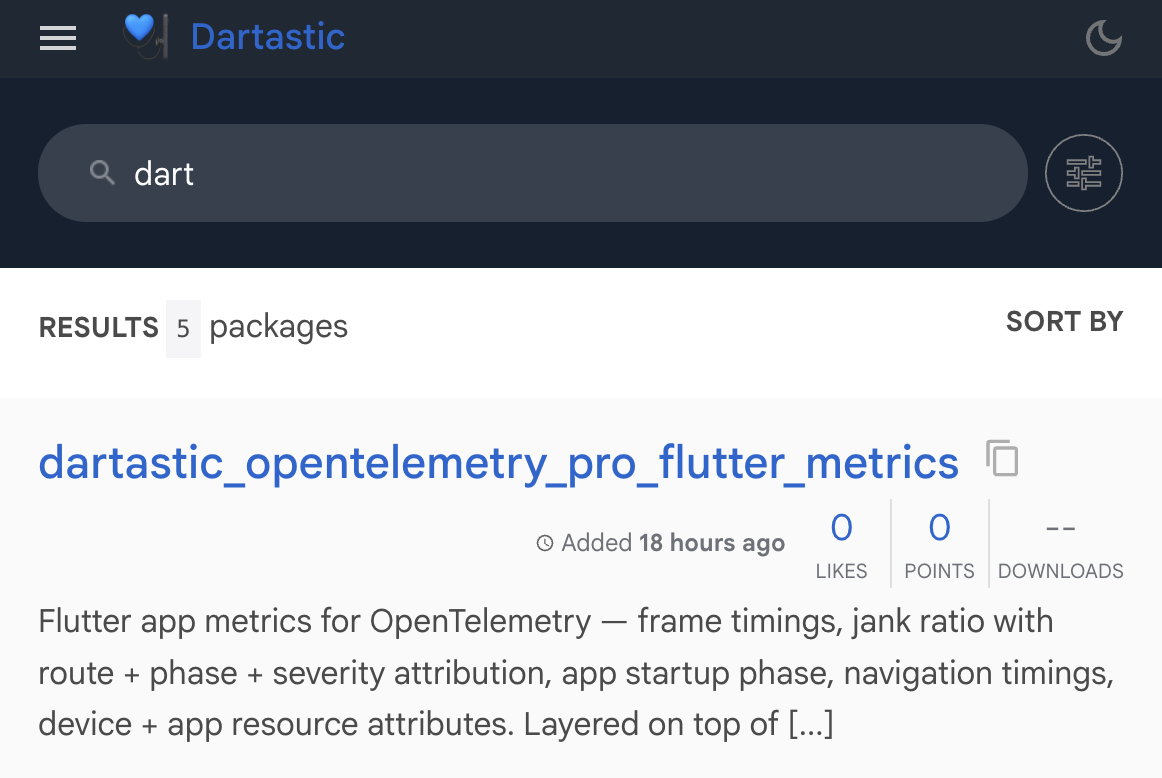
Pub.dev, Privately
Dartastic Pub has a familiar pub.dev feel, but your packages are private. Share your releases with your team, customers, development partners, and testers, without sharing with the world.
Dartastic Pub speaks the same protocol as pub.dev. Familiar commands like dart pub publish and flutter pub get work unchanged. Mint tokens in the Dartastic dashboard, scope them to specific packages with read or read/write privileges. Consumers register tokens with the standard dart pub token add to access your private registry. Works in CI/CD systems. No new tooling. No new mental model.
Includes
- Your own private pub for your private Dart and Flutter packages.
- Familiar pub.dev feel with new capabilities.
- Team and app management.
- Fine-grained access control with fast revocations.
- Daily backups, dual-region storage.
- Free with 100 MB, enough for dozens of packages.
- Just $4/mo for 10 GB per member of your organization, pooled.
- Dartastic Pub uses shared infrastructure. Dartastic Pub on private infrastructure is available with Dartastic Observatory and Dartastic OTel plans.
PUB PRO
Every dependency passes through here. So this is where you stop one.
A scanner that emails you about a bad version is a report. A registry that refuses to serve it is a control. Pub Pro turns your private Pub into the second one.
Policy that blocks, not warns
Refuse versions that are vulnerable, unmaintained, yanked, or break your licence policy. On Free and Pub Dev, advisories show up as warnings in dart pub get and everyone scrolls past them. On Pub Pro the resolve fails, which is the only version of this that changes behaviour.
Built for how Dart actually ships
A tool built for another ecosystem checks what your project declares and stops there. Pub Pro is built for Dart and Flutter specifically, and looks at what a package can actually do once it is in your build, not just what it says about itself.
Public packages, on your terms
Public packages come in through Dartastic Pub instead of around it, so your policy applies to everything your apps depend on, not just the packages you wrote. One place to see what they really pull, and one place to stop it.
Know when a package changes hands
Maintainer-change and typosquat alerts. Most real incidents are not a clever exploit, they are a trusted package quietly acquiring a new owner, or a name one character away from the one you meant. Private packages are scanned too, not just the public ones.
SBOM export in CycloneDX and SPDX, and Slack alerts. $20 per seat per month, 5 seat minimum. Included with Dartastic OTel Pro, Hosted and Self-hosted.
See Pub pricingThings git hosting can't do at all
Retract without breaking builds
Shipped a bad version? Retract it: the solver stops picking it, while builds already pinned to it keep working. Deleting a git tag does the opposite: it breaks every consumer pinned to it, immediately. When your registry is private, publishing isn't "forever."
Crash reports that name your source
Flutter apps published here ship their .symbols in the archive. The Dartastic Symbolizer auto-fetches them and turns obfuscated production stack traces into real file and line. One publish per release. A git tag carries no artifacts at all.
Run like infrastructure
Per-package publish and read tokens, access logs, revocations in seconds, daily dual-region backups. Your dependency supply chain, treated like the production system it is.
Quick start
One-time per machine: register the token. Then publish or consume like normal pub.dev. Just point at pub.dartastic.io.
# Mint a key on dartastic.io/control-room/tokens with the `pub` scope
# (the plaintext key is shown ONCE at mint time). Then paste it after you run this:
dart pub token add https://pub.dartastic.io
Don't use the interactive dart pub token add: its silent Enter secret token: prompt truncates Dartastic's long signed tokens, so it appears to hang. Pipe the token in, as above.
Publishing
# pubspec.yaml
name: my_private_package
version: 1.0.0
publish_to: https://pub.dartastic.io
dart pub publishConsuming
# pubspec.yaml
dependencies:
  my_private_package:
    hosted: https://pub.dartastic.io
    version: ^1.0.0
Subscribe to get access
Dartastic Pub gets you the private pub server. Dartastic Symbolizer adds the Dartastic Symbolizer and the OTel Dev runtime.